Within & Without the Walls of Queens County Civil Court

I am sitting on a cold marble bench just outside the Jury Panel room and notice the thick glass walls of the building, the architectural expression of transparency.  This is my first time appearing for jury duty selection. While I am awed and admiring of the process, it is still all uncomfortably new.  I was glad to see outside those glass walls a row of pale yellow daffodils right at the base. They stood around the curved perimeter of the wall, about 10 rows deep,  scattered in uneven columns. The Spring breeze shook their heavy, lacy heads just enough to make them bob up and down, like hordes of people praying at the Wailing Wall. I contemplated their pastel happiness of being free, ruled only by the laws of wind, dirt, and sun.  Such a contrast from the complex yokes we carried around within these walls by people on all sides of our man-made laws.

Suddenly a voice announced that we must enter the room and so I filed in with everyone else, pondering these two distinct worlds of nature and man.  The intangible web of laws suspending and surrounding all of us humans was now to be the matter at hand.  Thank you, beautiful, delicate, sunny daffodils, for gracing me with your beauty before I face whatever serious job lies ahead.

3.29.00

The Bend in Our Universe

Time travelers have always known that there is a bend in the universe leading to all yesterdays that could have been.  People lead “normal” lives there, with trees, schools, and newspapers, differing only from ours because of a chance occurrence that created a quirky fork in the road.

Simply for the fact that someone was born or not, our world proceeded on this different path. To visit your alter-existence, you must go beyond our Milky Way to enter a non-space, anti-gravitational space-time disequilibrium. But be sure you are well protected with moon-tan lotion as there are several hundred moons plus one sun that might come around during the night.

Unfortunately, people there pay for things with Thank-You’s instead of money, so their economy is very vibrant but chaotic. What appears to be paper currency is used to wrap presents or as wallpaper. You might find your alter-grandmother in her living room making you a new hat to wear on your nose, or perhaps you can peek at your other self in the bathroom showering with flowers instead of water.

Unfortunately, everything is not peaceful there since Gandhi was never born. The streets are filled with posters commanding that we must recycle our discarded chewing gum into glue. Also, all animals have three feet and it is necessary to keep them from falling by giving them props to lean against. People are born as ancient adults, then progress down to childhood and infancy, eventually returning to the womb of an ancient woman, who will then continue to her own infancy, etcetera. You know, the cycle of life.

In short, everything might appear rosy, yet there is that irksome feeling that something is missing. So you see, nothing in your own world was for nothing. In order to be comfortable where you are, where you live, and with who you are, that butterfly you had sat on without thinking about it last summer during your canoeing trip had somehow played a part in your life as it is today. That other universe does know the cure for all cancers, but is plagued by polio and dysentery. Our world’s integral calculus is their world’s music, and our art is their religion. Time travelers who have ventured beyond our known galaxies into this wrinkled up time-space have seen the difference that a single bacterium has made within our own world — the one that led to penicillin.

I guess our alter egos in that other universe can be just about as happy or unhappy as we are in ours. It is still really a matter of how we choose to react, isn’t it?  I wouldn’t mind those three-legged animals, though. What a laugh I’d get watching cute, constantly slumping sheep.

(Seoul, Korea, 1996)

Reflections of Tomorrow

How many times have I looked out of my bedroom window to dream of my future, pausing from homework to peer into the distant lives of others passing by?  It has been a frame for my thoughts, maybe blinds for my soul, and a glass for my own reflections.

The cherry blossoms and other gently shaped trees on the lawn outside our apartment complex in Queens, NY, sculpted by dozens of unknown hands, sway in a park where cloud-hopping birds and high-jumping squirrels come to rest from the stress of our concrete wilderness. I often look out of my window with hands on my chin, arms resting on my desk, daydreaming about the world.

Whenever it is the winter holidays, all of these trees sparkle as a huge pine tree plus a huge menorah get added to the entrance. The tree gets adorned with a glittering star atop, while the menorah sparkles and glows its blessings each night.  When snow falls as I watch from our fourth floor apartment, the sandy carpet of white covering the entire park completes the holiday picture, and the apartments are bathed in a soft, hazy light.

I adore my little bedroom window for illuminating my soul, standing between who I am today and who I dream of becoming tomorrow.

 (Stuyvesant High School, NYC)

The Poet Is A Bear

You probably wouldn’t know this man if he told you his name.  You probably wouldn’t recognize him even if he were sitting in front of you on the subway and you were reading a book with his photo on the back cover. Galway Kinnell is a poet who truly values his relative anonymity despite winning a Pulitzer Prize and writing many highly acclaimed books of poetry.

The Saturday Review describes Kinnell as a poet who finds it difficult to identify with all the “hoopla” about himself. He prefers the freedom and safety of anonymity versus the limelight, and is careful not to let his success “overcome and poison him.” He aspires to live each day with that same feeling of wonder he had as a boy growing up on Avenue C on the Lower East Side in Manhattan.

Frankly, I had never heard of Galway Kinnell until I took a poetry elective in Mrs. Kocela’s class as a junior at Stuyvesant High School in NYC.

Avenue C is alluded to in Kinnell’s work, “Avenue Bearing the Initial of Christ into the New World,” a major book of his poetry.  Mrs. Kocela, went with me to Rizzoli’s on Fifth Avenue around Christmas to pick up a copy, but they were sold out. They had another of Kinnell’s works,  “The Book of Nightmares’, so she bought it and then later surprised me with it as a gift, signing it, “Love, Judyth”.  From there we sojourned uptown to the 92nd Street Y where there would be a poetry seminar for students hosted by Mr. Kinnell.  My friend Ben Clark, myself, and some selected high school students from other Manhattan schools had been invited to participate.

The seminar room was dark and sparse because it was currently being prepared for an upcoming photography exhibit. As we slowly and silently gravitated toward the long mahogany seminar table, unsure of what would soon transpire, we tried avoiding one another’s gazes at all costs. Instinctively we felt a strong need to keep our defenses because we knew that “poetry seminar” was a euphemism for “personal criticism seminar.”

After a ruddy and squirmish twenty minutes’ delay, the large oak doors finally opened. Our collective blushing was apparent when we looked up to see the quickly entering figure.

Mr. Kinnell darted in, navy jacket half-off, his strands of wavy chestnut hair windswept in an unnatural slant. He was a large man, late 40s, with disproportionately large hands, and with  eyes laminated by the enthusiasm of a new world explorer. A quick remark about heavy traffic and it was on to a reading of his latest poem, on blackberries of all things.

We were at once struck and transformed by his poetry reading style and the playful twists of language. Somehow poetry seemed less of a bully, no longer intimidating or dull, coming to life and taking up residence in Mr. Kinnell for the next several hours.  Through his poems he  showed all of us how beautiful and powerful language could be when words are selected with care, when the essence of a mood is conveyed in a tight, economic yet still musical fashion, and of how simplicity can reigns over overly-complex imagery.

Each student was then asked to read a poem of her own aloud, after which we would all comment on them. Warning! Warning!   We sheepishly tugged out our papers, bracing ourselves for a possible verbal mauling which to some extent did occur, leaving our egos cracked but not shattered.

We noticed that Mr. Kinnell listened very intently to us and was genuinely interested not only in our creativity but in each of us as young adults searching for ourselves.

I had come to this poetry seminar armed with several good poems, but for some reason decided to read my worst one, hoping to get some constructive advice. But as soon as I read it aloud, I observed its shoddy structure, entangled imagery and loose mixed metaphors, so I  quickly regretted it. I just knew I had these really killer poems in my binder, but it was too late.

Mr. Kinnell remarked on some areas of improvement while maintaining a supportive tone.  I was completely crestfallen, but had my chance later to redeem myself when we all gathered for another round, but this time at podium in front of a room full of people at the 92nd St Y,  the audience full of students, teachers and anyone else who happened to gambol into the room… Danger! Danger!

I was chosen to be the first, and so read my poem, “The Rebel”, which was much more introspective and better constructed than my initial fiasco about a cherry tomato. The snapshot of Mr. Kinnell’s face in reaction to what I had just read is one I will never forget. He radiated true satisfaction. And maybe surprise? He asked me about some of the lines in it and I, shocked that he had such an interest in it as much to ask,  simply replied that it was inspired by my grandfather.

Before reading my work, I did make a very short comment about why I wrote it, and therefore set a precedent — a short background, the reading itself, then questions from Mr. Kinnell and the audience.  Took hours for all of us to finish, but we all enjoyed such power at having our words and thoughts be treated with so much importance, and to be seen as a form of beauty.

After it was all over and we returned to our homes, using his advice on word selection I began searching for how I would describe Galway Kinnell, the poet.  He was a large black bear sitting on a slab of rock, fur glistening in the rain, eating blackberries, contented and unrepining in mid-forest at the thrill of the entire experience, compelled by bear-ness to simply be.

It was a huge day and experience for us acne-laced high school kids, searching through the power of the word to find ourselves, and of our unique place in the universe.

(Stuyvesant High School, NYC, 1983)
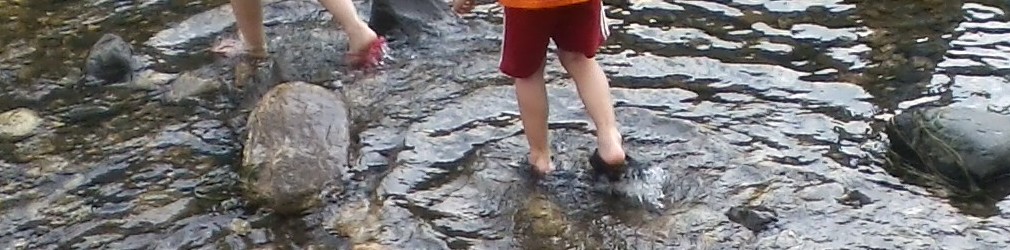
BARREL MUSIC

A strand of fugue
from barrel’s depth
shoots out a trill.

Chimes & cymbals,
clanging my earrings
like cowbells.

I step right in.

Toes soaked in fugue water,
a bucket of Bach
to wash me in clefs.

The soapy tonal underbelly,
a reflection of the inverse,
an unbraided melody.

Washed in arpeggios,
skin glistening with Bach oil,
I dive in to meet music’s
mischievous genius.

Carried away by water music,
I am saved
by
drowning.

Summer 1984